The Battle of the Somme by Alan Axelrod
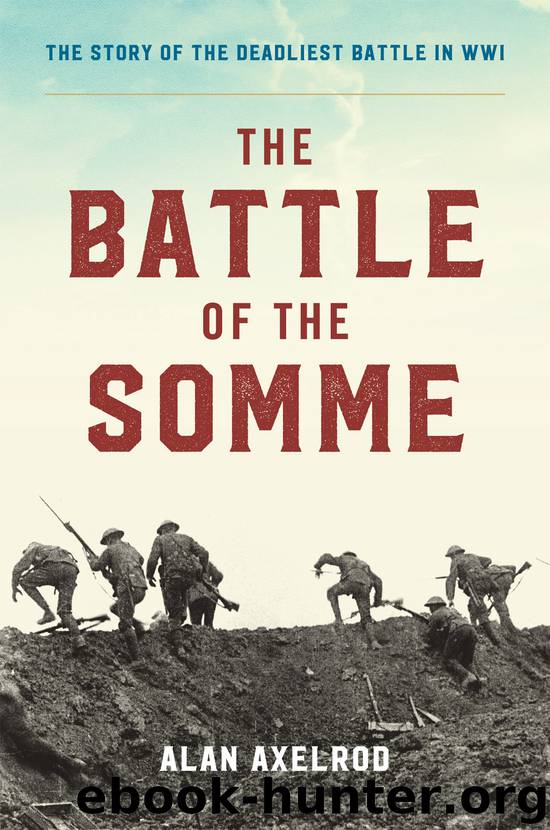
Author:Alan Axelrod
Language: eng
Format: epub
ISBN: 9781493022090
Publisher: Lyons Press
Published: 2016-07-29T04:00:00+00:00
CHAPTER 7
South of the Ancre
MANY OF THE SURVIVORS OF THAT FIRST MORNING OF BATTLE TO THE north of the Ancre River were those who had lived to make significant progress toward or even into the German trenches. They saw their comrades fall and fall in great numbers, but they lived and attained some objective. The point of view of these individuals was often surprisingly optimistic, even triumphant. A second lieutenant, Eric Miall-Smith, wrote home to describe what he called a “glorious victory” and proudly claimed that he had “done my bit” by killing four Germans. As his unit approached the enemy trenches, the Germans “threw down their arms and rushed forward to shake our men by the hands.”1
The “big picture,” especially on the south bank of the Ancre, was very different, as Cecil Lewis, a Royal Flying Corps airman on observation duty, reported. Troops on the ground could either place large canvas groundsheets to indicate their unit’s progress or fire flares when an observation aircraft was spotted. Lewis saw no groundsheets at all and just two flares on a front encompassing the operations area of an entire corps. “From our point of view an entire failure,” he duly noted, in his logbook that morning, of the attacks in the Mash Valley and Sausage Valley area. He returned for another look in the afternoon and once again reported “a complete failure,” admitting later to being “bitterly disappointed.”2
In most places along the Somme front, Allied and enemy trenches were separated by hundreds of yards, usually from five hundred to nine hundred. In most places, the Germans had positioned machine guns to create overlapping, interlocking fields of fire. Sometimes they opened up on the British attackers as they came out of their trenches. Sometimes they began the slaughter as the Tommies worked their way through narrow gaps in the British wire. Elsewhere, artillery and machine guns took their toll in the middle of no-man’s-land or at the German wire. The expanse dividing the trenches was, for a magnificently well-entrenched enemy, an almost limitless opportunity for killing. And so the British rarely reached their objectives in anything like sufficient numbers to hold them for long.
The men of the 36th (Ulster) Division, for example, took the Schwaben Redoubt but soon relinquished it for lack of reinforcements. That was the usual pattern on July 1, 1916. Reduced by terrible losses suffered while going over the top and then advancing through no-man’s-land, men from the early waves would claw their way to the frontline German trenches. Some of the enemy would surrender, but most made a tactical withdrawal to the second line of trenches. From here, they fought the invaders of their first line, and the British would struggle to hold out until the arrival of reinforcements. The problem was that, by the time the first or second wave had attacked, German artillery and machine guns had thoroughly “registered” on the routes of advance across no-man’s-land—the places where shell holes and uncut wire yielded to reasonably clear ground.
Download
This site does not store any files on its server. We only index and link to content provided by other sites. Please contact the content providers to delete copyright contents if any and email us, we'll remove relevant links or contents immediately.
| Africa | Americas |
| Arctic & Antarctica | Asia |
| Australia & Oceania | Europe |
| Middle East | Russia |
| United States | World |
| Ancient Civilizations | Military |
| Historical Study & Educational Resources |
The Radium Girls by Kate Moore(12097)
100 Deadly Skills by Clint Emerson(4975)
Rise and Kill First by Ronen Bergman(4842)
The Templars by Dan Jones(4740)
The Doomsday Machine by Daniel Ellsberg(4559)
The Rape of Nanking by Iris Chang(4267)
Killing England by Bill O'Reilly(4046)
Stalin by Stephen Kotkin(4010)
Hitler in Los Angeles by Steven J. Ross(3983)
12 Strong by Doug Stanton(3583)
Hitler's Monsters by Eric Kurlander(3389)
The Code Book by Simon Singh(3255)
Blood and Sand by Alex Von Tunzelmann(3244)
Darkest Hour by Anthony McCarten(3164)
The Art of War Visualized by Jessica Hagy(3048)
Hitler's Flying Saucers: A Guide to German Flying Discs of the Second World War by Stevens Henry(2779)
Babylon's Ark by Lawrence Anthony(2723)
Tobruk by Peter Fitzsimons(2565)
The Second World Wars by Victor Davis Hanson(2555)
